Feeling like your paycheck disappears before the month even ends? You’re definitely not alone.
In 2026, everyday costs — groceries, rent, gas, utilities — keep climbing, and most Americans are searching for real, practical ways to stretch their dollars further. The good news? You don’t need a financial degree or a six-figure salary to start saving money fast.
These 15 strategies are simple, realistic, and can start saving you money as early as this week. No gimmicks. No extreme sacrifices. Just honest tips that work for real people on real budgets.
Let’s dive in.
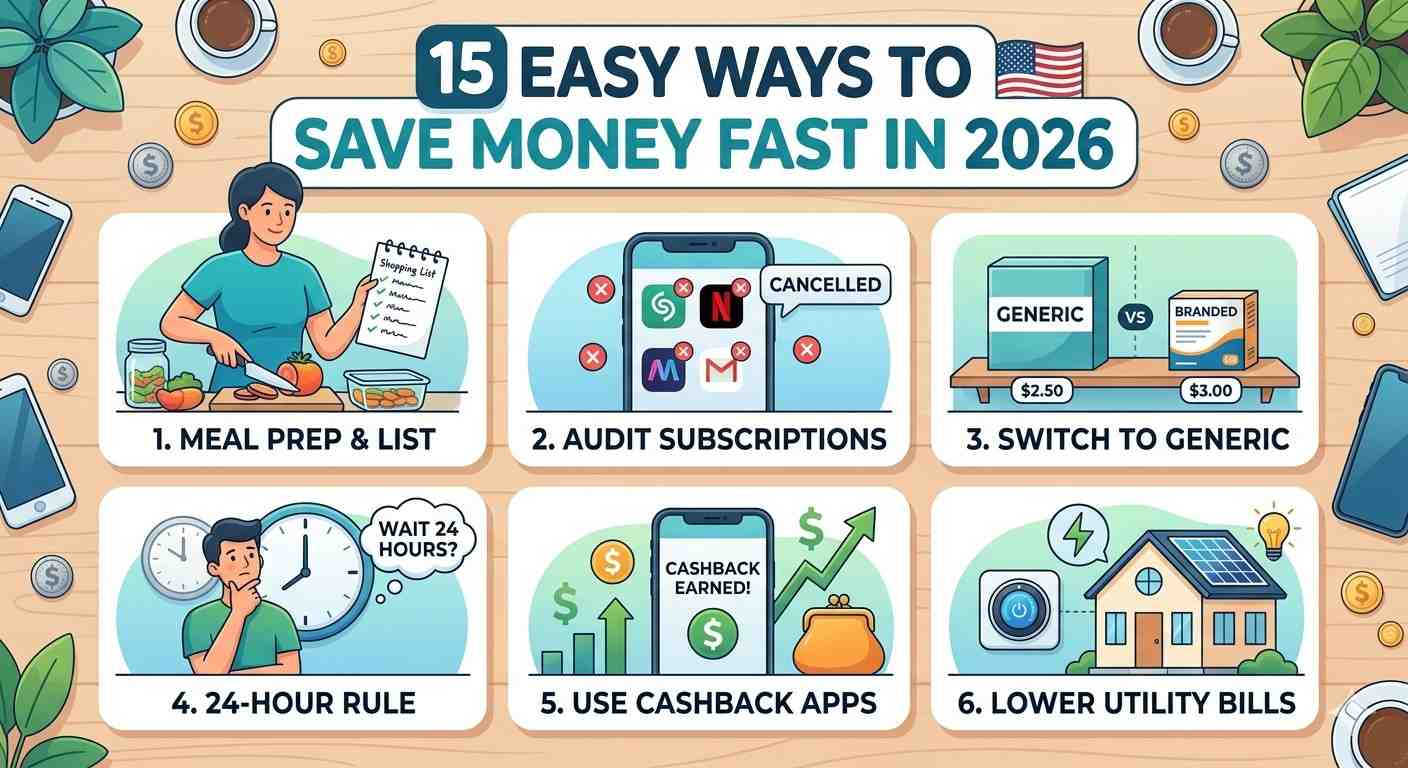
1. Do a “Subscription Audit” Right Now
Grab your bank statement and highlight every single recurring subscription charge. Netflix, Hulu, Disney+, gym memberships, meal kit services, apps — they all add up fast.
The average American spends over $200/month on subscriptions they barely use. Cancel anything you haven’t used in the last 30 days. You can always resubscribe later — but that money back in your pocket is instant savings.
Action step: Set a 15-minute timer, open your bank app, and cancel at least 3 subscriptions today.
2. Switch to Generic Brands at the Grocery Store
This is one of the fastest ways to cut your grocery bill without changing what you eat. Store-brand products — from cereal to cleaning supplies to medications — are often made by the same manufacturers as name brands, just with a different label.
Simply switching to generic brands on your top 10 grocery items can save the average American family $100–$150 per month without any lifestyle change whatsoever.
Pro tip: Start with cleaning products, over-the-counter medications, and pantry staples. These are where generic brands are virtually identical to name brands.
3. Meal Prep Every Sunday
Impulse eating is one of the biggest budget killers in America. When you’re hungry and tired after work, that $14 takeout order feels totally worth it — until it happens four times a week.
Meal prepping on Sunday takes about 2 hours and can save you $200–$400 per month in food costs. Cook large batches of rice, proteins, and vegetables that can be mixed and matched throughout the week.
Beginner meal prep idea: Cook a big pot of rice, roast a sheet pan of vegetables, and grill 2 lbs of chicken. That’s 5 days of lunches for under $20.
4. Use the 24-Hour Rule for Non-Essential Purchases
Before buying anything that isn’t food, medicine, or a bill — wait 24 hours. This one simple rule can dramatically reduce impulse purchases.
Most of the time, after 24 hours, you’ll realize you didn’t really need the item. This rule alone saves some people $300–$500 per month in unnecessary purchases they would have regretted anyway.
How to do it: When you feel the urge to buy something, add it to a “wishlist” on your phone. If you still want it after 24 hours — and it fits your budget — then buy it guilt-free.
5. Lower Your Utility Bills With These Simple Switches
Your monthly utility bills are a goldmine for savings if you know where to look:
- Unplug electronics when not in use — “phantom power” costs the average American $100–$200 per year
- Lower your thermostat by 2 degrees — saves approximately $10/month per degree
- Switch to LED bulbs — uses 75% less energy than traditional bulbs
- Wash clothes in cold water — saves $60–$100 per year
- Air dry dishes instead of using the heated dry cycle
Combined, these small switches can save you $50–$150 per month on utility bills alone.
6. Use Cashback Apps Every Single Time You Shop
If you’re not using cashback apps, you’re literally leaving free money on the table. Apps like Rakuten, Ibotta, and Fetch Rewards give you real cash back on purchases you’re already making.
- Rakuten — cashback on online shopping at 3,500+ stores
- Ibotta — cashback on groceries and everyday essentials
- Fetch Rewards — scan any receipt and earn points redeemable for gift cards
Americans using all three apps consistently save an average of $50–$100 per month in cashback rewards — for doing absolutely nothing different.
7. Negotiate Your Bills (Yes, You Can Do This)
Most Americans don’t realize that many monthly bills are actually negotiable. Your internet provider, insurance company, and even your credit card interest rate can often be reduced simply by calling and asking.
Script to use: “Hi, I’ve been a loyal customer for X years. I’m considering switching to a competitor because I found a better rate. Is there anything you can do to help me stay?”
This simple phone call saves people an average of $30–$100 per month on bills they assumed were fixed.
8. Plan Your Grocery Shopping With a List (And Stick To It)
Americans waste an average of $1,500 per year on food that gets thrown away. The fix is simple — plan your meals before you shop and buy only what you need.
The system:
- Check what’s already in your fridge and pantry
- Plan 5–7 dinners for the week
- Write a specific grocery list based on those meals
- Never shop hungry
- Stick to the list — no exceptions
This system alone can reduce your grocery bill by 20–30% immediately.
9. Cancel Cable and Switch to Streaming Bundles
The average American cable bill is $120–$180 per month in 2026. Meanwhile, you can get Netflix + Hulu + Disney+ bundled for under $25/month.
Cutting cable saves the average household $1,200–$1,800 per year — that’s a serious chunk of change for a one-time decision that takes 15 minutes.
Even better: Many public libraries offer free access to streaming services like Kanopy and Hoopla — completely free with your library card.
10. Start a No-Spend Challenge
A no-spend challenge means choosing a set period — one week, two weeks, or even a full month — where you spend money only on absolute necessities: rent, utilities, groceries, and gas.
No restaurants. No shopping. No impulse buys.
Families who complete a 30-day no-spend challenge typically save $500–$1,500 depending on their normal spending habits. Plus, it permanently resets your relationship with money.
Start small: Try a no-spend weekend first. You’ll be surprised how much you save — and how much fun you still have.
11. Buy Everything Second-Hand First
Before buying anything new — furniture, clothes, kitchen appliances, kids’ toys, books — check these platforms first:
- Facebook Marketplace — local deals, often 50–80% off retail
- ThredUp — like-new clothing at fraction of retail price
- OfferUp — local secondhand everything
- Craigslist — furniture, appliances, tools
Buying secondhand on just 3–4 purchases per month can easily save $100–$300 monthly depending on what you need.
12. Use a Zero-Based Budget Every Month
Most people have no idea where their money actually goes. A zero-based budget fixes that by giving every single dollar a job before the month begins.
How it works:
- List your total monthly income
- Assign every dollar to a category (rent, groceries, savings, fun money, etc.)
- Income minus all expenses = $0
When every dollar has a purpose, overspending becomes nearly impossible. Apps like EveryDollar and YNAB (You Need a Budget) make this process simple and free.
13. Refinance or Consolidate High-Interest Debt
If you’re carrying credit card debt at 20–29% interest, you’re essentially setting money on fire every month. Refinancing or consolidating that debt into a personal loan at a lower interest rate can save you hundreds of dollars per month in interest charges alone.
Options to explore:
- Personal loans through your bank or credit union
- Balance transfer credit cards with 0% intro APR
- Debt consolidation services
Even reducing your interest rate from 24% to 12% on a $5,000 balance saves you approximately $600 per year in interest.
14. Grow Your Own Herbs and Vegetables
Fresh herbs at the grocery store cost $2–$4 per bunch and go bad within days. Growing your own herbs at home costs about $3 for a seed packet that produces herbs for an entire season.
Even in a small apartment, you can grow:
- Basil, cilantro, parsley, mint — on a sunny windowsill
- Cherry tomatoes — in a small pot on a balcony
- Lettuce and spinach — in a shallow container indoors
A small herb and vegetable garden can save a family $30–$80 per month on fresh produce and herbs.
15. Start One Simple Side Hustle
The fastest way to improve your financial situation is to increase your income. And in 2026, there are more ways than ever to earn extra money from home without a special degree or experience.
Easy side hustles to start this week:
- Selling unused items on Facebook Marketplace or eBay
- Freelance services on Fiverr (writing, design, data entry)
- Delivery driving with DoorDash or Instacart (flexible hours)
- Survey sites like Swagbucks or Survey Junkie (small but easy)
- Print-on-demand shops on Etsy or Redbubble
Even earning an extra $200–$500 per month from a side hustle dramatically changes your financial picture.
How Much Can You Actually Save?
Let’s add it up realistically:
| Strategy | Monthly Savings |
|---|---|
| Cancel subscriptions | $50–$100 |
| Generic brands | $100–$150 |
| Meal prepping | $200–$400 |
| Cashback apps | $50–$100 |
| Negotiate bills | $30–$100 |
| Cut cable | $100–$150 |
| Buy secondhand | $100–$300 |
| Total potential savings | $630–$1,300/month |
Final Thoughts
Saving money fast in 2026 doesn’t mean you have to live miserably. It means making smarter, more intentional decisions with the money you already have.
Start with just 3 of these tips this week. Pick the easiest ones first. Build momentum. Then add more strategies as they become habits.
Small changes, done consistently, create massive results over time. Your future self — with a full savings account and zero financial stress — will thank you.
Which tip are you going to try first? Save this post so you can come back to it! 📌