
Let’s be honest — most budget advice out there is either too complicated, too extreme, or just completely out of touch with real life.
“Stop buying coffee!” Great advice — except your $5 latte isn’t why you’re broke.
“Invest 20% of your income!” Amazing — but what if there’s nothing left after rent and groceries?
The truth is, budgeting doesn’t have to be painful, complicated, or miserable. It just has to be smart.
These budget hacks are different. They’re simple, realistic, and actually work for everyday Americans living real lives in 2026. No extreme couponing. No giving up everything you love. Just smart, practical moves that keep more money in your pocket every single month.
Let’s get into it.
Contents
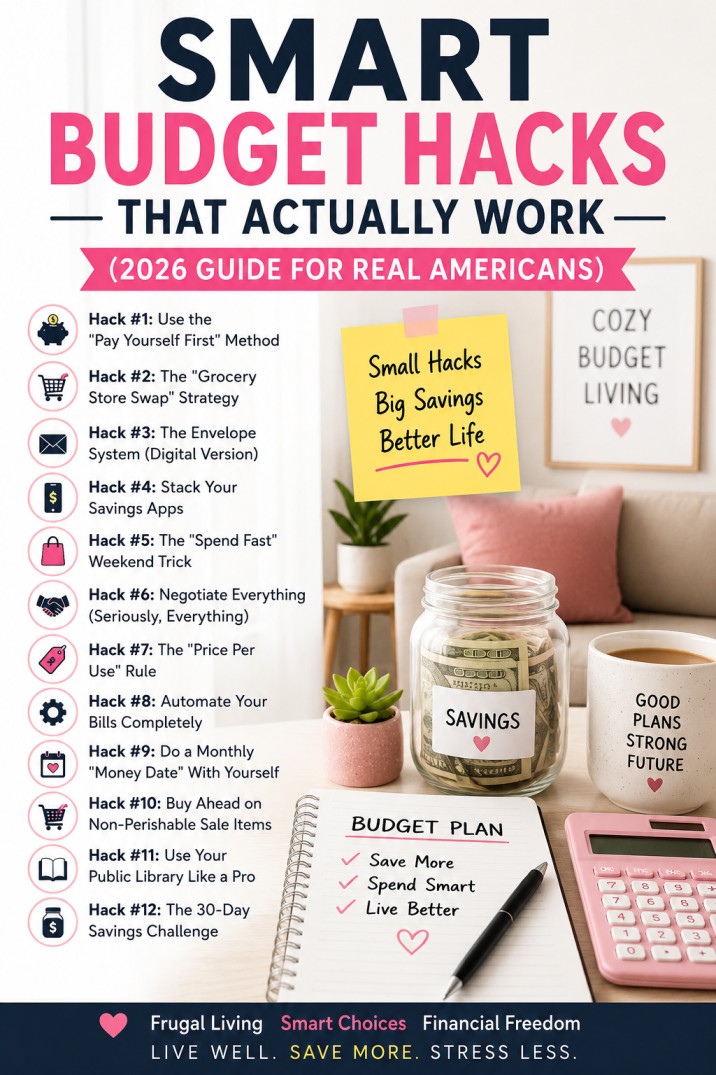
- 1 Hack #1: Use the “Pay Yourself First” Method
- 2 Hack #2: The “Grocery Store Swap” Strategy
- 3 Hack #3: The Envelope System (Digital Version)
- 4 Hack #4: Stack Your Savings Apps
- 5 Hack #5: The “Spend Fast” Weekend Trick
- 6 Hack #6: Negotiate Everything (Seriously, Everything)
- 7 Hack #7: The “Price Per Use” Rule
- 8 Hack #8: Automate Your Bills Completely
- 9 Hack #9: Do a Monthly “Money Date” With Yourself
- 10 Hack #10: Buy Ahead on Non-Perishable Sale Items
- 11 Hack #11: Use Your Public Library Like a Pro
- 12 Hack #12: The 30-Day Savings Challenge
- 13 How Much Can These Hacks Save You?
- 14 Final Thoughts
Hack #1: Use the “Pay Yourself First” Method
Most people budget like this — pay all the bills, spend what’s left, and hope there’s something to save at the end of the month.
Spoiler: there never is.
The “Pay Yourself First” method flips this completely. The moment your paycheck hits your account, immediately transfer a set amount — even just $25 or $50 — directly into your savings account before you pay anything else.
Treat your savings like a bill that must be paid. Non-negotiable. Automatic. Done.
Set up an automatic transfer on payday so you never even see the money. Within 6 months, most people using this method save $300–$600 they never thought they could.
Action step: Log into your bank app right now and set up a $25 automatic transfer to savings on your next payday.
Hack #2: The “Grocery Store Swap” Strategy
Here’s a hack that saves the average American family $150–$200 per month without eating any differently.
Instead of always shopping at your usual grocery store, compare prices at:
- Aldi — consistently 30–40% cheaper than traditional grocery stores
- Lidl — similar savings, great quality
- Costco — bulk buying saves money for families
- Walmart Grocery — price matching and rollbacks
Simply switching your main grocery shopping from a traditional supermarket to Aldi alone saves most families $100+ per month immediately.
Pro tip: Shop at Aldi for staples (produce, dairy, meat, canned goods) and only visit your regular store for specific items you can’t find elsewhere.
Hack #3: The Envelope System (Digital Version)
The old-school cash envelope system actually works — but nobody carries cash anymore. Here’s the modern version:
Create separate savings buckets in your bank account (most banks offer this free) for each spending category:
- Groceries
- Gas
- Entertainment
- Clothing
- Emergency fund
When a bucket is empty — that category is done for the month. No exceptions.
This visual system makes overspending nearly impossible because you can see exactly how much is left in each category at any moment. Apps like Qube Money and Goodbudget do this automatically.
People using the envelope system consistently spend 20–30% less than those without a budget system.
Hack #4: Stack Your Savings Apps
One cashback app is good. Three cashback apps stacked together is a money-saving machine.
Here’s the stack that saves Americans the most money:
Step 1 — Rakuten: Before shopping online at any store, go through Rakuten first. Earn 1–15% cashback at 3,500+ stores including Walmart, Target, and Amazon.
Step 2 — Ibotta: Before grocery shopping, check Ibotta for cashback offers on items you already planned to buy. Scan your receipt after shopping to earn cash.
Step 3 — Fetch Rewards: Scan every single receipt — grocery, gas, restaurants, anywhere. Earn points on every purchase redeemable for free gift cards.
Step 4 — Your Credit Card: Pay for everything with a cashback credit card (paid in full monthly) to earn an additional 1.5–5% back on every purchase.
Stacking all four consistently saves the average American $75–$150 per month in cashback rewards — for purchases they were already making.
Hack #5: The “Spend Fast” Weekend Trick
Pick one weekend per month — any weekend — and declare it a zero-spend weekend.
No restaurants. No shopping. No online ordering. No impulse buys.
Instead, use what you already have. Cook from your pantry. Watch movies you already own or use free library streaming. Go for hikes, visit free museums, or have friends over for a potluck.
Most Americans spend $200–$400 on unnecessary weekend purchases without even realizing it. One zero-spend weekend per month saves you $100–$200 and resets your spending habits for the rest of the month.
Bonus: You’ll often discover pantry ingredients you forgot you had — saving even more on groceries that week.
Hack #6: Negotiate Everything (Seriously, Everything)
Americans leave thousands of dollars on the table every year because they assume bills are fixed. They’re not.
Bills you can negotiate right now:
- Internet/cable bill — call and say you’re thinking of switching
- Car insurance — get competing quotes annually and ask your current provider to match
- Credit card interest rate — call and ask for a lower APR
- Medical bills — always ask for an itemized bill and negotiate cash-pay discounts
- Rent — especially at renewal time, ask for a discount or added perks
Script that works: “Hi, I’ve been a loyal customer for [X] years. I recently found a better rate with [competitor]. I’d love to stay, but I need you to help me out. What can you do?”
This one phone call — repeated across 3–4 bills — can save you $100–$300 per month on expenses you thought were fixed forever.
Hack #7: The “Price Per Use” Rule
Before buying anything non-essential, calculate the price per use.
Formula: Item cost ÷ Number of times you’ll use it = Price per use
Examples:
- $200 KitchenAid mixer used 200 times = $1 per use ✅ Worth it
- $80 trendy top worn twice = $40 per use ❌ Not worth it
- $15/month gym membership used 20x = $0.75 per workout ✅ Worth it
- $15/month gym membership used 2x = $7.50 per workout ❌ Cancel it
This simple calculation stops impulse purchases instantly. When you realize that cute $60 top will cost you $30 per wear — suddenly it’s not so cute anymore.
Hack #8: Automate Your Bills Completely
Late fees are one of the most ridiculous ways to waste money. The average American pays $150–$300 per year in completely avoidable late fees.
Set up autopay for every single recurring bill:
- Rent or mortgage
- Utilities
- Insurance
- Credit cards (minimum payment at least)
- Phone bill
- Internet
Five minutes of setup today eliminates late fees forever. Just make sure you keep enough buffer in your checking account to cover autopayments.
Bonus hack: Schedule all autopayments for 2–3 days after your payday so you always have money in your account when bills hit.
Hack #9: Do a Monthly “Money Date” With Yourself
Once a month — same day, same time — sit down for 30 minutes and review your finances. Call it your Money Date.
What to do during your Money Date:
- Review last month’s spending by category
- Identify your top 3 overspending areas
- Adjust next month’s budget accordingly
- Check your savings progress
- Celebrate any wins — even small ones
People who review their finances monthly consistently save 15–20% more than those who ignore their money until something goes wrong.
Make it enjoyable — pour yourself a nice drink, put on your favorite playlist, and treat it like a self-care ritual rather than a chore.
Hack #10: Buy Ahead on Non-Perishable Sale Items
When non-perishable items you regularly use go on sale — buy as many as you can reasonably store.
Items worth stocking up on:
- Toilet paper and paper towels
- Laundry detergent and cleaning supplies
- Canned goods and dry pasta
- Coffee and tea
- Shampoo, soap, and personal care items
- Over-the-counter medications
Buying 6 bottles of dish soap at 40% off saves more money than any coupon ever will — and you were going to buy it eventually anyway.
Families who stock up strategically save an average of $100–$200 per month on household essentials.
Hack #11: Use Your Public Library Like a Pro
Your public library card is one of the most underutilized money-saving tools in America. With a free library card you get access to:
- Free books — obviously
- Free ebooks and audiobooks via Libby app
- Free movies and TV shows via Kanopy and Hoopla
- Free magazine subscriptions via PressReader
- Free online courses via LinkedIn Learning (some libraries)
- Free museum passes (many libraries offer these)
- Free notary services
- Free Wi-Fi and computer access
The average American spends $150–$200 per month on entertainment. Your library card replaces most of that — for free.
Hack #12: The 30-Day Savings Challenge
This beginner-friendly challenge builds the savings habit without feeling overwhelming:
- Day 1: Save $1
- Day 2: Save $2
- Day 3: Save $3
- Continue until Day 30: Save $30
Total saved in 30 days: $465
By the end you’ve saved nearly $500 AND built a daily savings habit that sticks. Many people who complete this challenge continue saving automatically — because it no longer feels hard.
How Much Can These Hacks Save You?
| Hack | Monthly Savings |
|---|---|
| Pay yourself first | $25–$200 |
| Grocery store swap | $100–$200 |
| Stack cashback apps | $75–$150 |
| Zero-spend weekends | $100–$200 |
| Negotiate bills | $100–$300 |
| Stop late fees | $15–$25 |
| Library card | $100–$150 |
| Total potential savings | $515–$1,225/month |
Final Thoughts
The secret to budgeting successfully isn’t willpower or extreme sacrifice — it’s building smart systems that work automatically in the background of your life.
You don’t have to do all 12 hacks at once. Pick just 2 or 3 that feel most doable right now. Master those. Then add more.
Small, consistent improvements compound over time into massive financial results. Six months from now, you’ll look back and be amazed at how much your financial life has changed — one smart hack at a time.
Which budget hack are you trying first? Save this post to Pinterest so you can refer back to it anytime! 📌
Related Posts You’ll Love:
3 thoughts on “Smart Budget Hacks That Actually Work (2026 Guide for Real Americans)”