There is a moment in almost every frugal living journey when something clicks — when you stop looking for more ways to earn money and start looking more carefully at where the money you already earn is quietly disappearing.
For me, that moment came when I reviewed three months of bank statements and realized I was spending hundreds of dollars every month on things I could not specifically remember buying, did not specifically need, and — when I really thought about it — was not making my life any better.
The 7 things I stopped buying to save money are not dramatic sacrifices. I did not give up things I genuinely loved. I gave up things I was buying out of habit, convenience, social pressure, or clever marketing — and discovered that life without them was actually better in almost every measurable way.
If you are looking for specific, actionable things to stop buying to save money — without the vague advice to “cut back on things you don’t need” — this is the honest, detailed account you have been looking for.
Contents
- 1 Why Stopping Certain Purchases Matters More Than Budgeting
- 2 Thing #1: Paper Towels
- 3 Thing #2: Bottled Water
- 4 Thing #3: Individual Snack Packages
- 5 Thing #4: Name Brand Cleaning Products
- 6 Thing #5: Magazine and Newspaper Subscriptions
- 7 Thing #6: Gym Membership
- 8 Thing #7: Impulse Grocery Items
- 9 Complete Savings Summary
- 10 The Honest Truth About Stopping These Purchases
- 11 How to Find Your Own List
- 12 Frequently Asked Questions
- 13 Q: What are the easiest things to stop buying to save money immediately?
- 14 Q: How long does it take to adjust after stopping these purchases?
- 15 Q: Will I feel deprived if I stop buying these things?
- 16 Q: What should I do with the money I save?
- 17 Conclusion
Why Stopping Certain Purchases Matters More Than Budgeting
Most personal finance advice focuses on budgeting — tracking every dollar, assigning money to categories, staying within limits. And budgeting is valuable.
But there is a more powerful approach that most people overlook — identifying the specific purchases that are draining your money without adding real value to your life, and simply stopping them.
The difference is significant.
Budgeting says “I will spend $180 per month on coffee shops instead of $300.”
Stopping a purchase says “I realized coffee shop visits were a habit I had built around convenience and social approval rather than genuine enjoyment — so I stopped, and I have not missed them.”
One approach manages a spending pattern. The other eliminates it entirely. The financial results — and the mental peace — of the second approach are dramatically greater.
These are the 7 things I stopped buying to save money completely — and the honest reasoning behind each decision.
Thing #1: Paper Towels
Monthly savings: $15–$25 Annual savings: $180–$300
This was the first thing I stopped buying — and the one that surprised me most with how easy the transition was.
I was buying two to three rolls of paper towels per week. At $2 to $3 per roll, that was $4 to $9 per week — over $400 per year on something I was using once and throwing away.
The replacement was a $12 investment in a pack of 12 microfiber cloths. I use them for everything I used paper towels for — wiping counters, cleaning spills, washing windows, drying hands. I wash them with regular laundry. They have been in use for over a year and still look and function perfectly.
The honest truth: I do not miss paper towels at all. The microfiber cloths work better — they are more absorbent, leave fewer streaks on glass, and do not disintegrate mid-wipe the way paper towels do when something is particularly wet.
The only adjustment was building the habit of grabbing a cloth instead of reaching for the paper towel roll. That took about one week.
What I do instead: Microfiber cloths for everything. One dedicated cloth per area — kitchen, bathroom, windows. Wash weekly with regular laundry.
Thing #2: Bottled Water
Monthly savings: $20–$40 Annual savings: $240–$480
I was buying a case of bottled water every one to two weeks. Twelve to twenty-four bottles at $4 to $8 per case — plus the individual bottles I bought on the go at $2 to $3 each.
The math when I finally added it up was genuinely embarrassing — approximately $300 to $400 per year on water. Water that comes out of my tap for essentially free and that — in most American cities — is tested more rigorously than bottled water.
The replacement was a $35 Brita filter pitcher and two $20 reusable water bottles. Total one-time investment: $75. The filter replacements cost about $7 every two months — $42 per year. Compared to $300 to $400 for bottled water.
The honest truth: The filtered tap water tastes identical to the bottled water I was buying. There is no difference I can detect. I was paying for the convenience of individual bottles and the psychological comfort of a brand name — neither of which I actually needed.
What I do instead: Brita pitcher in the refrigerator. Reusable bottle refilled every morning. Done.
Thing #3: Individual Snack Packages
Monthly savings: $30–$60 Annual savings: $360–$720
Single-serve snack packages — individual bags of chips, single-serving crackers, portion-sized nuts, small packs of trail mix — are one of the most aggressively marked-up products in any grocery store.
A single-serving bag of almonds that costs $2.50 at a gas station contains approximately 1.5 ounces of almonds. A 16-ounce bag of the same almonds at Costco or Walmart costs $7 to $9. The per-ounce price difference is 400 to 600 percent.
I was buying individual snack packages constantly — for work, for the car, for kids’ lunches, for convenience. I was paying four to six times more per ounce than I needed to simply because I had never done the math.
The replacement system: Buy snacks in bulk — large bags of almonds, pretzels, dried fruit, crackers, granola. Portion them into reusable containers at home. The cost per serving drops dramatically. The preparation time is about 15 minutes per week.
What I do instead: Bulk buying at Costco, Sam’s Club, or Walmart. Portioning at home on Sunday during meal prep. Small reusable containers for on-the-go snacking.
Thing #4: Name Brand Cleaning Products
Monthly savings: $20–$50 Annual savings: $240–$600
I detailed this extensively in my budget cleaning hacks post — but it deserves its place on this list because stopping this purchase was one of the most impactful and easiest changes I made.
I was spending $25 to $40 per month on a cabinet full of specialized cleaning products — bathroom cleaner, kitchen cleaner, glass cleaner, floor cleaner, tile cleaner, stainless steel cleaner, drain cleaner, toilet bowl cleaner, fabric freshener. Eleven different products for eleven supposedly different cleaning needs.
They have been entirely replaced by three ingredients: white vinegar ($4 per gallon), baking soda ($2 per box), and blue Dawn dish soap ($5 per bottle). These three items clean every surface in my home as effectively as the eleven commercial products they replaced — for about $11 total per year instead of $300 to $480.
What I do instead: DIY all-purpose spray (vinegar + water), baking soda for scrubbing and deodorizing, Dawn for everything else. The complete recipes are in my budget cleaning hacks post.
Thing #5: Magazine and Newspaper Subscriptions
Monthly savings: $20–$60 Annual savings: $240–$720
This one felt like a genuine sacrifice when I stopped — and turned out to be almost completely painless within two weeks.
I had three magazine subscriptions and one newspaper subscription. Combined monthly cost: approximately $45. Annual cost: $540.
I told myself these subscriptions were worth it because I was staying informed, supporting journalism, and enjoying quality reading material. All of which was partially true.
What was more true was that I was reading approximately 20 percent of each magazine before the next one arrived, and spending 15 minutes skimming the newspaper app each morning primarily out of habit.
The replacement: My public library card gives me free access to hundreds of magazine titles through the PressReader app — including most of the magazines I was subscribing to. The library also provides free digital access to major newspapers through the same app.
I get the same reading material. I pay nothing. The library funds it through tax dollars I was already paying regardless of whether I used this benefit or not.
What I do instead: PressReader through my library card for magazines and newspapers. NPR and quality podcasts for news. The information quality has not declined at all.
Thing #6: Gym Membership
Monthly savings: $30–$80 Annual savings: $360–$960
I want to be careful here — gym memberships are worth every dollar for people who use them consistently. This item on my list is specifically about the gym membership I was not using consistently.
I had a gym membership for two years. In those two years, I used the gym regularly for approximately four months total. For the other twenty months, I was paying $45 per month — $900 — for a service I was not using, while telling myself I would “get back to it soon.”
When I finally canceled, I replaced the gym with a combination of free alternatives that I actually use consistently because they fit my real schedule and preferences rather than the schedule and preferences I had imagined for myself.
Free fitness alternatives that I actually use:
- Running outside — free, fresh air, genuinely enjoyable
- YouTube workout channels — Yoga with Adriene, Heather Robertson, Sydney Cummings — all completely free
- Bodyweight workout app — free version more than sufficient
- Hiking on local trails — free, beautiful, better cardio than any treadmill
- Resistance bands — $15 one-time purchase, hundreds of workout options
What I do instead: YouTube workouts three times per week. Running twice per week. Zero monthly cost. Higher consistency than I ever achieved at the gym.
Thing #7: Impulse Grocery Items
Monthly savings: $50–$150 Annual savings: $600–$1,800
This is the one that took longest to change — and the one that has saved the most money.
Impulse grocery items are the things that end up in your cart that were not on your list — the interesting-looking sauce you might try someday, the candy bar at checkout, the new product you want to experiment with, the sale item that seemed too good to pass up even though you have no immediate use for it.
Research consistently shows that shoppers who shop without a list spend 20 to 40 percent more than shoppers who shop with one. For the average American grocery bill of $150 to $200 per week, that is $30 to $80 per week in unplanned purchases — $1,560 to $4,160 per year.
The fix is not complicated — but it requires a habit change that takes several weeks to stick.
My system: Build a complete weekly meal plan every Sunday. Create a specific grocery list from that plan. At the store — list only. If something not on the list catches my attention, I photograph it with my phone and add it to a “consider next week” note. If I still want it next Sunday — I add it to the list. If not — forgotten.
This system has virtually eliminated impulse grocery purchases while still allowing me to try new things intentionally rather than reactively.
What I do instead: Weekly meal plan every Sunday without exception. Specific grocery list from that plan. Phone photo method for tempting items. Complete adherence to the list in the store.
Complete Savings Summary
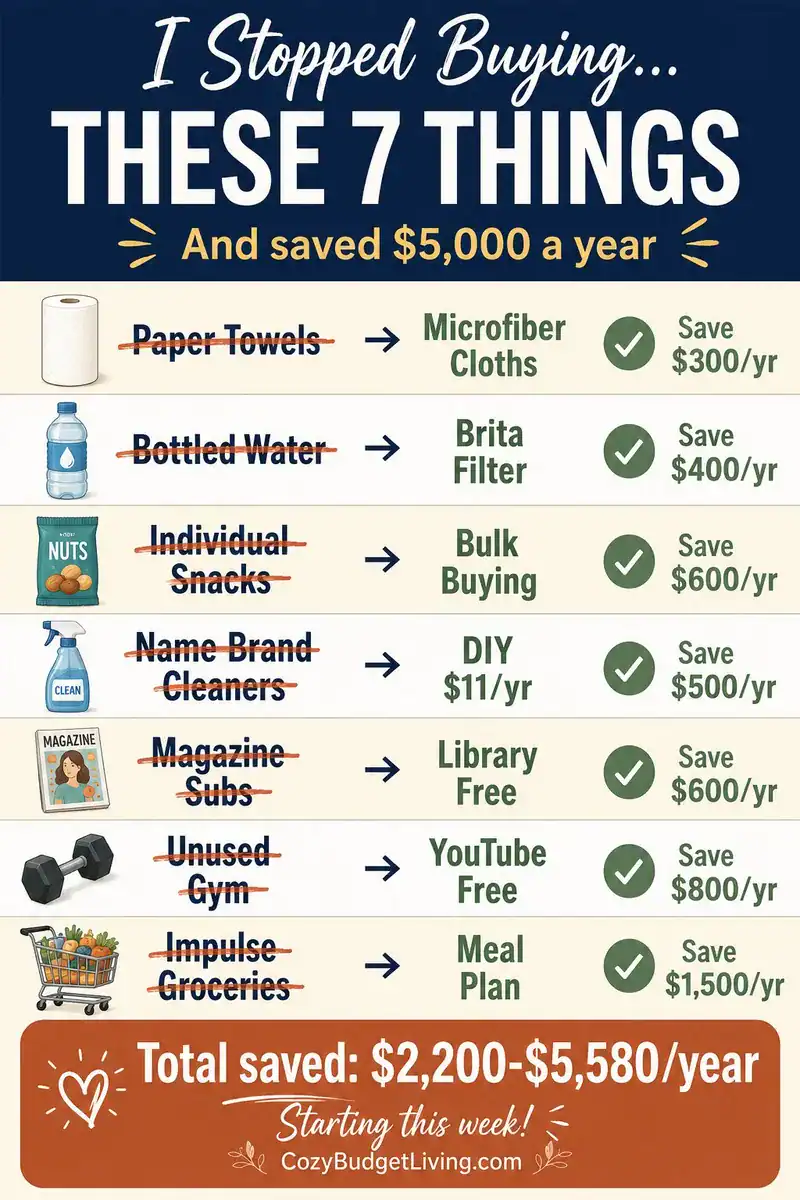
| Thing Stopped | Monthly Savings | Annual Savings |
|---|---|---|
| Paper towels | $15–$25 | $180–$300 |
| Bottled water | $20–$40 | $240–$480 |
| Individual snack packages | $30–$60 | $360–$720 |
| Name brand cleaning products | $20–$50 | $240–$600 |
| Magazine subscriptions | $20–$60 | $240–$720 |
| Unused gym membership | $30–$80 | $360–$960 |
| Impulse grocery items | $50–$150 | $600–$1,800 |
| Total | $185–$465/month | $2,220–$5,580/year |
The Honest Truth About Stopping These Purchases
Every item on this list felt like it might be a sacrifice when I stopped. None of them turned out to be.
Paper towels were a convenience habit — microfiber cloths are genuinely better. Bottled water was a psychological habit — filtered tap water is identical. Individual snacks were a laziness habit — bulk buying takes 15 minutes per week. Name brand cleaners were a marketing habit — DIY cleaners work as well. Magazine subscriptions were a good intentions habit — the library provides the same content for free. The gym membership was an aspirational habit — free exercise options I actually use have replaced it completely. Impulse groceries were an autopilot habit — a list takes 15 minutes to write.
Every single one of these purchases was a habit rather than a genuine need or genuine enjoyment. And habits — once you see them clearly for what they are — are surprisingly easy to change.
How to Find Your Own List
The 7 things I stopped buying to save money are specific to my life. Your list will be different — and probably just as surprising when you see it clearly.
How to identify your own list:
Review three months of bank and credit card statements. Highlight every recurring purchase or category of purchase that appears regularly. Ask one question about each: is this genuinely improving my life — or is it a habit I never consciously chose?
The items that are habits rather than genuine choices are your list. The savings from stopping them are your opportunity.
Frequently Asked Questions
Q: What are the easiest things to stop buying to save money immediately?
Paper towels, bottled water, and individual snack packages are consistently the easiest to stop immediately because the replacements are simple, inexpensive, and deliver better results in most cases. Start with these three and see how manageable the transition is before tackling more emotionally complex purchases.
Q: How long does it take to adjust after stopping these purchases?
Most habit adjustments take two to four weeks before the new behavior feels natural. The first week is the hardest — you reach for the paper towel roll that is no longer there, you look for the water bottles that you no longer buy. By week three, the new habits are largely automatic.
Q: Will I feel deprived if I stop buying these things?
Based on my experience and the experience of most people who make these changes — no. The items on this list are habits rather than genuine pleasures. You cannot feel deprived of something you were doing automatically rather than intentionally. What most people feel instead is surprised — both by how easy the transition is and by how much money was quietly leaving their accounts for these habits.
Q: What should I do with the money I save?
Automate it. The moment you calculate your monthly savings from stopping these purchases, set up an automatic transfer for that amount to your savings account on payday. The money you were spending unconsciously becomes savings that grow automatically — and the behavioral change that seemed small turns into a meaningful financial transformation over months and years.
Conclusion
The 7 things I stopped buying to save money changed my financial life — not through dramatic sacrifice or radical lifestyle changes, but through the simple act of seeing my habits clearly and deciding that the money flowing toward them could be doing something better.
None of these changes required willpower after the first few weeks. None of them made my life less enjoyable. Several of them — the microfiber cloths, the DIY cleaners, the outdoor exercise — actually improved my daily experience compared to what they replaced.
Start with one item from this list this week. Just one. See how easy the transition is. See how quickly you stop missing the thing you stopped buying. And see what happens to your bank account when that money stops disappearing every month.
Save this post to Pinterest and share it with someone who needs to see it! 📌
Related Posts You’ll Love: