
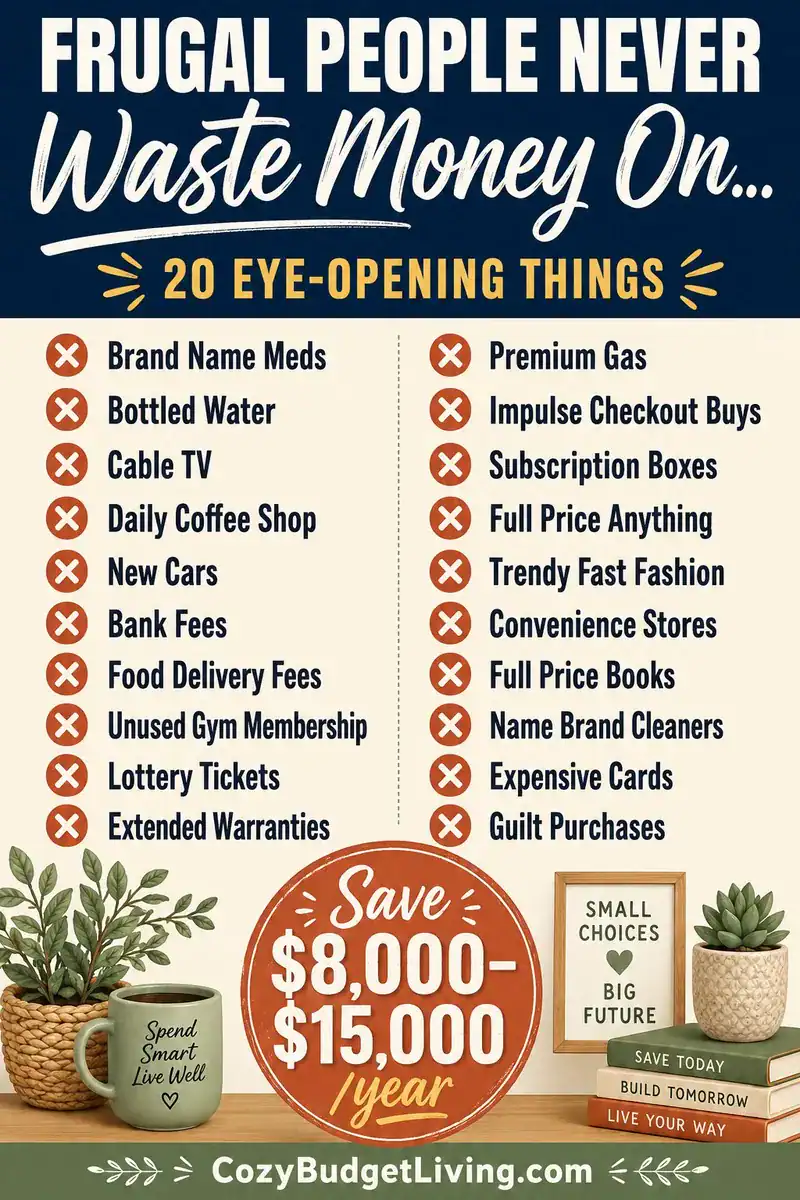
Have you ever wondered what genuinely frugal people do differently with their money?
It is not that they earn more. It is not that they never enjoy life. And it is definitely not that they deprive themselves of everything good.
The real difference between people who are quietly building wealth and people who are constantly stressed about money comes down to one thing — what they choose NOT to spend money on.
Truly frugal people have identified the specific categories where most Americans quietly hemorrhage money every single month — and they have simply stopped. Not because they cannot afford these things, but because they have realized these expenses provide almost zero real value in return for the money spent.
This list covers the 20 things frugal people never waste money on — and more importantly, what they do instead. Because frugal living is never about deprivation. It is about redirection — moving money away from things that do not matter toward things that genuinely do.
Contents
- 1 1. Brand Name Medications
- 2 2. Extended Warranties on Most Products
- 3 3. Bottled Water
- 4 4. Lottery Tickets
- 5 5. Cable Television
- 6 6. Daily Coffee Shop Visits
- 7 7. Impulse Purchases at Checkout
- 8 8. Unused Gym Memberships
- 9 9. New Cars
- 10 10. Bank Fees
- 11 11. Food Delivery Apps
- 12 12. Premium Gas for Regular Cars
- 13 13. Trendy Items That Go Out of Style Quickly
- 14 14. Convenience Store Purchases
- 15 15. Buying Books at Full Price
- 16 16. Name Brand Cleaning Products
- 17 17. Subscription Boxes
- 18 18. Paying Full Price for Anything
- 19 19. Expensive Greeting Cards
- 20 20. Anything Bought Out of Guilt or Social Pressure
- 21 How Much Do These 20 Choices Save Every Year?
- 22 Frequently Asked Questions
- 23 Q: Does being frugal mean never spending money on enjoyable things?
- 24 Q: How do I start living more frugally without feeling deprived?
- 25 Q: What is the single biggest thing frugal people never waste money on?
- 26 Q: Are frugal people cheap?
- 27 Q: How long does it take to see results from frugal living?
- 28 Conclusion
1. Brand Name Medications
Frugal people never pay for the brand name on over-the-counter medications. The FDA requires generic medications to contain identical active ingredients in identical doses to their brand-name counterparts. Advil and generic ibuprofen are chemically identical. Tylenol and generic acetaminophen are the same product with different packaging.
What they do instead: Always reach for the generic version first. Most pharmacies place generics directly beside brand names — compare the active ingredients and choose the cheaper option every time. Savings: 50 to 80 percent on every medication purchase.
2. Extended Warranties on Most Products
Frugal people know that extended warranties are one of the highest-profit items retailers sell — which means they are one of the worst deals consumers can buy. Most products either fail within the manufacturer’s warranty period or last well beyond the extended warranty without issue.
What they do instead: Self-insure by putting the money they would have spent on warranties into a dedicated savings account. After a few years, this “warranty fund” covers any repair or replacement needed — and keeps growing because most products never need it.
3. Bottled Water
The average American spends $100 to $300 per year on bottled water. Frugal people consider this one of the most unnecessary expenses in modern American life — tap water in most US cities is tested more rigorously than bottled water and is virtually free.
What they do instead: Invest once in a quality water filter pitcher ($25–$40) or a faucet-mounted filter ($20–$35) and a reusable water bottle ($15–$25). This single purchase pays for itself within weeks and saves hundreds of dollars every year.
4. Lottery Tickets
Frugal people understand basic probability. The odds of winning a major lottery jackpot are approximately 1 in 292 million. The average American who buys lottery tickets regularly spends $500 to $1,000 per year on what is statistically one of the worst financial decisions available.
What they do instead: Invest that same money in a high-yield savings account or index fund. $50 per month invested consistently over 20 years grows to over $30,000 at a modest 5 percent return. The lottery has never made anyone wealthy through regular ticket purchases.
5. Cable Television
With Netflix, Hulu, Disney+, HBO Max, Peacock, and free options like YouTube and library streaming through Kanopy and Hoopla, frugal people see zero reason to pay $120 to $180 per month for cable television.
What they do instead: Choose one or two streaming services at $8–$15 per month. Rotate services every few months — subscribe to one, watch everything they want, cancel, and subscribe to the next. Annual entertainment cost drops from $1,800 to $200.
6. Daily Coffee Shop Visits
This is not about never enjoying a coffee shop — frugal people enjoy coffee shops as an occasional treat. It is about the daily $6 latte habit that costs $180 per month and $2,160 per year without most people even noticing.
What they do instead: Invest in a good home coffee setup. A French press costs $20. A quality bag of whole bean coffee costs $12 to $15. The same quality coffee at home costs $0.50 to $1.00 per cup instead of $5 to $7. Coffee shops become intentional weekly treats rather than mindless daily expenses.
7. Impulse Purchases at Checkout
Grocery stores, gas stations, and retailers deliberately place high-margin impulse items at checkout counters because they work. The average American spends $5,400 per year on impulse purchases — many of them at checkout counters.
What they do instead: Practice the rule of never buying anything at checkout that was not on their original list. They arrive at checkout with exactly what they planned to buy and leave with exactly that — nothing more. This single habit saves the average person $100 to $200 per month.
8. Unused Gym Memberships
January gym memberships are one of the most reliably wasted expenses in America. Studies show that the majority of gym memberships go unused within three months of purchase — yet people continue paying $30 to $80 per month for years out of guilt and good intentions.
What they do instead: Exercise for free. Walking, running, bodyweight workouts at home, free YouTube workout channels, hiking, and cycling all provide excellent fitness without any monthly fee. If a gym is genuinely used regularly — keep it. If not — cancel immediately.
9. New Cars
Frugal people understand one of the most important financial facts about cars — a new vehicle loses 15 to 25 percent of its value the moment it leaves the dealership. The average new car costs $48,000 in 2026 — a payment that handcuffs most American families financially for five to seven years.
What they do instead: Buy reliable used vehicles — typically two to four years old with low mileage. The original buyer has absorbed the dramatic initial depreciation. Frugal people drive cars they own outright or finance minimally, freeing hundreds of dollars per month for saving and investing.
10. Bank Fees
Monthly maintenance fees, ATM fees, overdraft fees, and minimum balance fees quietly drain hundreds of dollars from American bank accounts every year. Frugal people consider paying bank fees completely unacceptable — because avoiding them is entirely free.
What they do instead: Bank exclusively with fee-free institutions. Online banks like Ally, Marcus, Chime, and SoFi charge zero monthly fees, zero minimum balance requirements, and reimburse ATM fees. Switching takes 30 minutes and saves $150 to $300 per year immediately.
11. Food Delivery Apps
DoorDash, Uber Eats, and Grubhub charge delivery fees, service fees, small order fees, and tips that routinely add 30 to 50 percent to the cost of any restaurant meal. A $15 meal becomes a $22 to $25 meal by the time it arrives. Multiple deliveries per week costs the average American $200 to $400 per month extra in fees alone.
What they do instead: Meal prep on Sundays so there is always food ready to eat at home. When they want restaurant food, they pick it up themselves — eliminating all delivery fees. Occasional delivery becomes a genuine treat rather than a default solution.
12. Premium Gas for Regular Cars
Unless your vehicle’s manufacturer specifically requires premium fuel — which most vehicles do not — paying for premium gasoline provides zero benefit. Your car’s computer automatically adjusts for lower octane fuel and your engine performs identically on regular gas.
What they do instead: Always use regular unleaded unless the owner’s manual specifically says “premium required.” The savings of $0.40 to $0.70 per gallon adds up to $200 to $400 per year for most American drivers — for absolutely no sacrifice.
13. Trendy Items That Go Out of Style Quickly
Fast fashion, seasonal home decor, trendy gadgets, and other items designed around fleeting trends cost full price when new and are worth almost nothing within months. Frugal people recognize this cycle and refuse to participate in it.
What they do instead: Buy classic, timeless items that remain useful and attractive for years. When they do buy something trendy, they wait until it hits clearance — 60 to 80 percent off — or buy it secondhand for a fraction of the original price.
14. Convenience Store Purchases
Convenience stores charge a significant premium for everything they sell — gas, snacks, drinks, and basic grocery items routinely cost 40 to 100 percent more than the same items at a regular grocery store. Frugal people view convenience stores as emergency-only stops.
What they do instead: Keep a small snack bag in their car stocked with water, granola bars, and snacks bought at regular grocery prices. Never arrive somewhere hungry or thirsty without a plan. This single habit saves $50 to $150 per month for most Americans.
15. Buying Books at Full Price
Books are wonderful — frugal people love reading. But paying $15 to $30 for a new book when the same book is available for free is something frugal people simply never do.
What they do instead: Use their public library card to borrow physical books, ebooks through the Libby app, and audiobooks completely free. Buy used books on ThriftBooks, AbeBooks, or Facebook Marketplace for $1 to $5. Purchase new books only for titles they know they will read multiple times.
16. Name Brand Cleaning Products
Frugal people know that white vinegar, baking soda, dish soap, and water clean virtually every surface in a home just as effectively as any branded cleaning product — for a fraction of the cost.
What they do instead: Make simple DIY cleaning solutions or buy store-brand cleaning products. A bottle of white vinegar costs $3 and replaces $25 worth of branded cleaning products. Frugal people also buy cleaning products in bulk when on sale — dramatically reducing the per-use cost.
17. Subscription Boxes
Monthly subscription boxes — beauty boxes, snack boxes, book boxes, clothing boxes — seem exciting initially but rarely deliver consistent value relative to their cost. Most subscribers find themselves keeping two or three items and throwing away or donating the rest every month.
What they do instead: Buy exactly what they need when they need it. If they loved a product from a subscription box, they buy just that product directly — usually cheaper and without a monthly commitment. The discipline of buying intentionally beats the excitement of monthly surprises every time financially.
18. Paying Full Price for Anything
Frugal people almost never pay full retail price for anything that is not food or an urgent necessity. They understand that virtually every product goes on sale regularly — and that waiting patiently is one of the most profitable financial habits available.
What they do instead: Use cashback apps and browser extensions like Rakuten and Honey. Shop end-of-season clearance sales. Check Facebook Marketplace, OfferUp, and thrift stores before buying anything new. Set price alerts on Amazon for items they want. The combination of these habits saves frugal people thousands of dollars annually.
19. Expensive Greeting Cards
The average greeting card costs $5 to $10 at a traditional retail store. Dollar Tree sells greeting cards for $1.25 each — identical in quality and sentiment to their expensive counterparts. Frugal people see paying $8 for a card as one of the clearest examples of paying for a brand name that provides zero additional value.
What they do instead: Buy all greeting cards at Dollar Tree. Or better yet — write a heartfelt personal note on plain paper or a simple card. The thought and words matter infinitely more than the price of the card they are written on.
20. Anything Bought Out of Guilt or Social Pressure
This is the most expensive thing frugal people never waste money on — purchases driven by guilt, social pressure, keeping up appearances, or fear of judgment rather than genuine desire or need.
The vacation they cannot afford but feel pressured to take. The expensive gift for someone who would have been equally happy with something thoughtful and affordable. The new outfit purchased for one event to impress people they barely know. The restaurant everyone is going to that does not fit the budget.
What they do instead: Make financial decisions based on their own values and goals rather than external pressure. They have learned — often through experience — that the temporary discomfort of saying no or choosing a less impressive option is infinitely preferable to the lasting stress of financial decisions made to please others.
How Much Do These 20 Choices Save Every Year?
| Category | Annual Savings |
|---|---|
| Generic medications | $200–$400 |
| Skip extended warranties | $100–$300 |
| Ditch bottled water | $200–$300 |
| Cut cable | $1,200–$1,800 |
| Home coffee instead of daily cafe | $1,500–$2,000 |
| Skip food delivery fees | $1,500–$3,000 |
| No gym membership (unused) | $400–$1,000 |
| Buy used car instead of new | $3,000–$6,000 |
| Zero bank fees | $150–$300 |
| Regular vs premium gas | $200–$400 |
| Total potential savings | $8,450–$15,500/year |
Frequently Asked Questions
Q: Does being frugal mean never spending money on enjoyable things?
Absolutely not — and this is the most important thing to understand about genuine frugal living. Frugal people spend money intentionally on things that bring real joy and value. They simply stop spending on things that do not — which frees up significantly more money for the things that genuinely matter to them.
Q: How do I start living more frugally without feeling deprived?
Start by identifying your three biggest unnecessary expenses — not the ones that bring you genuine joy, but the ones you pay for out of habit, convenience, or social pressure. Eliminate those three first. Use the money you save to fund something you genuinely value. Frugal living feels like freedom, not deprivation, when approached correctly.
Q: What is the single biggest thing frugal people never waste money on?
New cars consistently represent the largest single unnecessary expense for most American families. The combination of depreciation, high monthly payments, insurance costs, and interest on financing makes a new car one of the most financially damaging purchases most Americans ever make. Buying reliable used vehicles is one of the highest-impact frugal choices available.
Q: Are frugal people cheap?
There is an important distinction between frugal and cheap. Frugal people spend intentionally — they are generous with people they care about, they invest in quality when it matters, and they enjoy experiences that bring real value. They simply refuse to waste money on things that provide no real return. Cheap people avoid spending even when it causes harm to themselves or others. Frugal is a financial strategy. Cheap is a character trait.
Q: How long does it take to see results from frugal living?
Most people who implement even five to ten of these habits see meaningful financial improvement within 30 to 60 days. The savings are immediate — every purchase not made is money immediately retained. The compounding effect of consistent frugal habits over months and years creates dramatic long-term financial transformation.
Conclusion
The 20 things frugal people never waste money on share one common characteristic — they are all expenses that provide far less real value than their cost suggests.
Generic medications work identically to brand names. Tap water is as safe as bottled. Used cars transport you just as reliably as new ones. Home coffee tastes just as good as cafe coffee. Free library books contain the same words as full-price purchased ones.
Frugal people have simply done the math — and decided that the money saved by skipping these expenses is worth infinitely more directed toward their actual goals and values.
Pick five things from this list that apply to your life. Stop spending money on them this month. See how different your bank account looks in 30 days.
Financial freedom is not built by earning more. It is built by wasting less — one intentional decision at a time.
Save this post to Pinterest and share it with someone who needs to see it! 📌
Related Posts You’ll Love: