
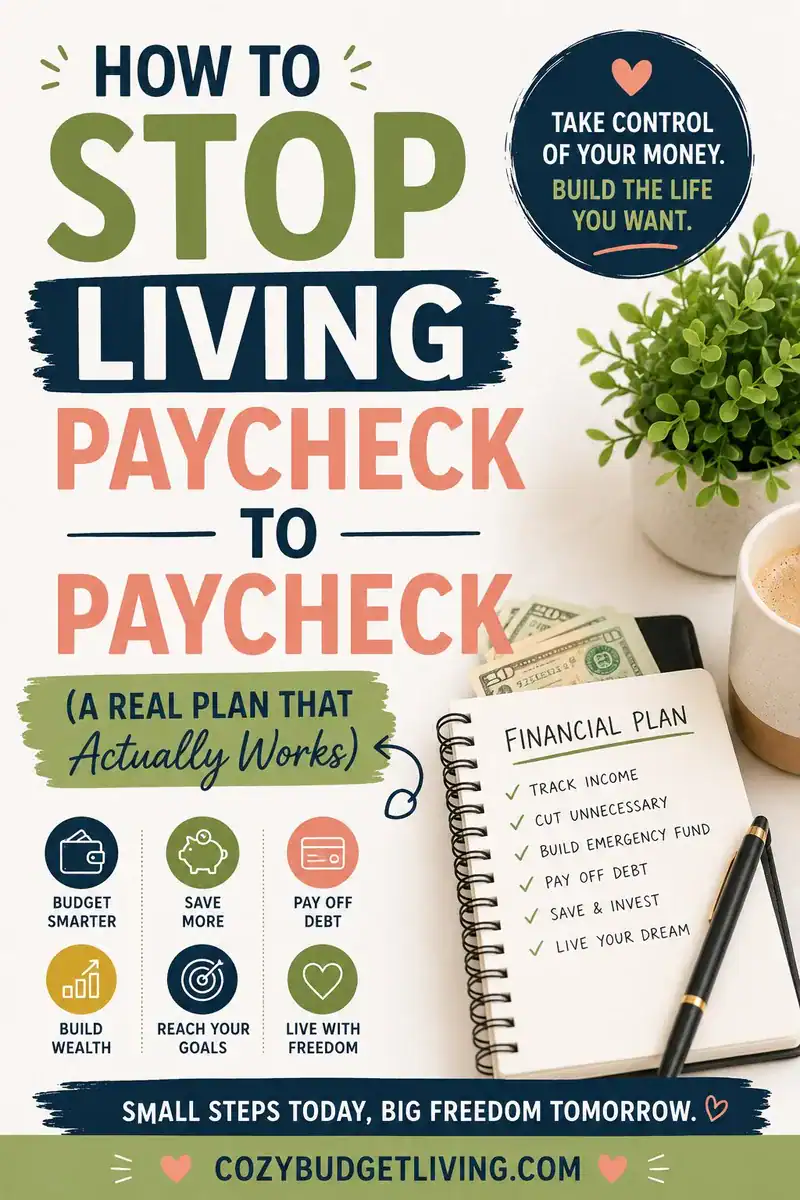
If you’re wondering how to stop living paycheck to paycheck, you are absolutely not alone.
According to recent surveys, nearly 78% of Americans live paycheck to paycheck — including people earning six figures. It’s not always about how much you make. It’s about what happens to your money between the first and the last day of the month.
If your bank account hits zero — or close to it — a few days before payday, this post is for you. Not the watered-down, generic advice you’ve read a hundred times. Real, step-by-step strategies that work for real American families right now in 2026.
Let’s break this cycle together.
Contents
- 1 Why So Many Americans Are Stuck Living Paycheck to Paycheck
- 2 Step 1: Know Exactly Where Your Money Is Going Right Now
- 3 Step 2: Build a Zero-Based Budget Before the Month Begins
- 4 Step 3: Cut Your Biggest Expenses First
- 5 Step 4: Build a $1,000 Emergency Fund First
- 6 Step 5: Attack Your Debt With Everything You Have
- 7 Step 6: Increase Your Income (This Is the Accelerator)
- 8 Step 7: Automate Everything So Willpower Isn’t Required
- 9 Step 8: Build a 3-Month Emergency Fund
- 10 What This Journey Actually Looks Like
- 11 Frequently Asked Questions
- 12 Conclusion
Why So Many Americans Are Stuck Living Paycheck to Paycheck
Before we fix the problem, let’s understand it.
Living paycheck to paycheck doesn’t mean you’re irresponsible or bad with money. It means the system is working exactly as designed — rent increases faster than wages, groceries cost more every month, and nobody teaches us how to manage money in school.
Here are the real reasons most Americans stay stuck:
- No written budget — money disappears without a plan
- Lifestyle inflation — income goes up, spending goes up equally
- High fixed expenses — rent, car payments, subscriptions eating most of the paycheck
- Zero emergency fund — one unexpected bill destroys everything
- Debt payments — credit card interest stealing money every single month
- No savings habit — saving whatever is “left over” means never saving anything
The good news? Every single one of these is fixable. Here’s how.
Step 1: Know Exactly Where Your Money Is Going Right Now
How to stop living paycheck to paycheck starts with one thing — brutal honesty about your spending.
Most people have no idea how much they’re actually spending in each category. They guess — and they’re almost always wrong by hundreds of dollars.
Do this today:
- Open your bank app or bank statement
- Go back exactly 30 days
- Write down every single transaction in categories:
- Housing (rent/mortgage)
- Food (groceries + restaurants + delivery)
- Transportation (car payment, gas, insurance, Uber)
- Subscriptions (Netflix, Hulu, gym, apps)
- Debt payments (credit cards, student loans)
- Everything else
Most people have one of two reactions when they do this exercise: shock at how much they spend on food delivery, or shock at how many subscriptions they forgot about.
Either way — you can’t fix what you can’t see. This is your starting point.
Step 2: Build a Zero-Based Budget Before the Month Begins
Once you know where your money is going, it’s time to tell it where to GO instead.
A zero-based budget means giving every single dollar a job before the month starts. Your income minus every assigned expense equals zero. Not because you’re broke — but because every dollar has a purpose.
How to build your zero-based budget:
Write down your total monthly take-home income. Then list every expense in priority order:
Tier 1 — The Four Walls (pay these first, always):
- Rent or mortgage
- Utilities (electric, water, heat)
- Groceries (basic food — not restaurants)
- Transportation to get to work
Tier 2 — Important Bills:
- Insurance (health, car, renters)
- Phone bill
- Internet
- Minimum debt payments
Tier 3 — Savings and Extra Debt Payoff:
- Emergency fund contribution
- Extra debt payment
- Sinking funds (car repair, medical, etc.)
Tier 4 — Lifestyle:
- Dining out
- Entertainment
- Clothing
- Personal spending
Assign every dollar. When the money runs out in a category — it’s done for the month. No exceptions.
Apps that make this easy: EveryDollar (free) or YNAB (You Need a Budget, $14/month — worth every penny for most people).
Step 3: Cut Your Biggest Expenses First
Most budget advice tells you to skip your morning coffee. But your $5 latte is not why you’re broke.
To stop living paycheck to paycheck, you need to attack your biggest expenses first — because that’s where the real money is hiding.
Housing:
- Can you get a roommate? Even $400/month extra changes everything
- Can you negotiate your rent at renewal?
- Is there a cheaper apartment that still meets your needs?
Transportation:
- Can you refinance your car loan at a lower rate?
- Can you drop to one car as a family?
- Can you work from home 2–3 days a week to cut gas costs?
Food:
- Switch your primary grocery store to Aldi (saves $150–$250/month)
- Meal prep on Sundays to eliminate takeout temptation
- Commit to eating out maximum once per week
Subscriptions:
- Cancel every subscription you haven’t used in 30 days
- The average American wastes $200+/month on forgotten subscriptions
- Set a calendar reminder to audit subscriptions every 3 months
Cutting these three categories alone — housing, transportation, and food — can free up $500–$1,000+ per month for most American families.
Step 4: Build a $1,000 Emergency Fund First
Here’s why most people never escape the paycheck to paycheck cycle — they have no buffer.
Every time they start making progress, something happens. The car breaks down. A medical bill arrives. The kids need school supplies. And because there’s no emergency fund, they go right back to square one — or deeper into debt.
Your first financial goal — before anything else — is a $1,000 emergency fund.
Not $10,000. Not three months of expenses. Just $1,000. This small cushion prevents 90% of financial emergencies from becoming financial disasters.
How to build $1,000 fast:
- Sell unused items on Facebook Marketplace — most people have $200–$500 worth of stuff sitting around
- Work one weekend of overtime or pick up a side gig for 2–3 weeks
- Cut all non-essential spending for 30 days and redirect it to savings
- Use your next tax refund entirely for this goal
Once you have $1,000 saved, you’ll feel a shift. The constant anxiety of “what if something goes wrong” gets quieter. That mental peace alone is worth every sacrifice.
Step 5: Attack Your Debt With Everything You Have
Debt payments are the biggest reason people stay stuck living paycheck to paycheck. Every dollar going to interest is a dollar that can’t build your future.
Two proven methods to pay off debt:
The Debt Snowball (recommended for motivation): List your debts smallest to largest, regardless of interest rate. Pay minimums on everything. Throw every extra dollar at the smallest debt. When it’s gone, roll that payment to the next debt. The momentum you build is psychologically powerful.
The Debt Avalanche (recommended for saving money): List your debts by interest rate, highest to lowest. Pay minimums on everything. Attack the highest interest rate debt first. This saves the most money mathematically.
Either method works. The best one is the one you’ll actually stick with.
Quick wins to throw at debt:
- Tax refund — all of it
- Side hustle income — all of it
- Cashback app earnings — all of it
- Canceled subscription money — redirect to debt
- Any raise or bonus — at least 50% to debt
Step 6: Increase Your Income (This Is the Accelerator)
Cutting expenses only gets you so far. At some point, the math requires more income.
The fastest way to stop living paycheck to paycheck is to earn more money — even temporarily — while keeping your spending flat.
Side hustles you can start this week:
- Sell on Facebook Marketplace — clear out your home and make $200–$500 fast
- DoorDash or Instacart — flexible delivery work, earn $15–$25/hour
- Freelance on Fiverr — writing, design, data entry, social media management
- Babysitting or pet sitting — Rover app makes it easy, $15–$25/hour
- Sell printables on Etsy — create once, earn forever
- Survey sites — Swagbucks, Survey Junkie ($50–$100/month passive)
Even earning an extra $300–$500 per month from a side hustle dramatically speeds up your journey out of the paycheck to paycheck cycle. That’s $3,600–$6,000 extra per year that goes entirely toward debt and savings.
Step 7: Automate Everything So Willpower Isn’t Required
Here’s the truth about personal finance — willpower runs out. Life gets busy. You get tired. And suddenly that money you meant to save gets spent on something else.
The solution is automation. Make the right financial decisions happen automatically, so you don’t have to make them every month.
Set up these automations today:
- Automatic savings transfer — the day your paycheck lands, automatically move $25–$100 to savings before you can spend it
- Automatic bill payments — every recurring bill on autopay to eliminate late fees forever
- Automatic debt payment — set a fixed extra payment to your target debt every payday
- Automatic investment — even $25/month into a Roth IRA starts building long-term wealth
When the money moves automatically, you never miss it. You simply live on what’s left — and your financial goals build themselves in the background.
Step 8: Build a 3-Month Emergency Fund
Once your $1,000 starter emergency fund is in place and you’ve made progress on debt, your next goal is a full 3-month emergency fund.
This means saving 3 months worth of your essential expenses (rent, utilities, food, transportation). For most American families, this is $5,000–$12,000.
With this fund in place, you are virtually unshakeable. Job loss, medical emergency, car breakdown — none of these events can send you back to paycheck to paycheck living. You have a real cushion.
Keep this money in a high-yield savings account (Marcus by Goldman Sachs, Ally Bank, or SoFi currently offer the best rates) so it earns interest while it sits there.
What This Journey Actually Looks Like
Let’s be real — this won’t happen overnight. Here’s a realistic timeline for most American families:
| Month | Focus | Milestone |
|---|---|---|
| Month 1 | Track spending + build budget | Know exactly where money goes |
| Month 2 | Cut expenses + start $1K fund | $500 saved |
| Month 3 | Complete $1K emergency fund | Financial cushion in place |
| Month 4–6 | Attack smallest debt | First debt paid off |
| Month 7–12 | Debt snowball momentum | Multiple debts eliminated |
| Year 2 | Build 3-month fund | True financial stability |
This is not a quick fix. It’s a lifestyle change. But every single step forward makes the next one easier — and the relief you feel along the way is indescribable.
Frequently Asked Questions
Q: How long does it take to stop living paycheck to paycheck?
For most Americans, meaningful progress happens within 60–90 days of following a real budget. Complete escape from the cycle — meaning a fully funded emergency fund and no high-interest debt — typically takes 12–24 months depending on income, expenses, and how aggressively you pursue it.
Q: What if my income barely covers my basic expenses?
If your income genuinely doesn’t cover your basic needs after cutting everything possible, increasing income becomes the priority. Focus on side hustles, overtime, or career advancement while making small cuts wherever possible. Even $200/month extra income changes your trajectory significantly.
Q: Should I save money or pay off debt first?
Build your $1,000 starter emergency fund first — even before aggressively paying debt. Without this cushion, every financial emergency sends you deeper into debt. After $1,000 is saved, focus on debt aggressively until it’s gone, then build your full 3-month emergency fund.
Q: What is the fastest way to stop living paycheck to paycheck?
The fastest combination is: cut your three biggest expenses (housing, transportation, food), start a side hustle, automate savings, and follow a zero-based budget every single month. Most people who do all four see dramatic results within 60 days.
Q: Is living paycheck to paycheck normal?
Unfortunately yes — nearly 78% of Americans report living paycheck to paycheck at some point. But normal doesn’t mean acceptable. With the right plan and consistency, breaking the cycle is absolutely achievable at almost any income level.
Conclusion
Learning how to stop living paycheck to paycheck is one of the most important — and most life-changing — financial decisions you will ever make.
It starts with awareness, moves through a real budget and expense cuts, builds momentum with debt payoff and savings, and accelerates with extra income. None of these steps are complicated. But they do require consistency and commitment.
Start with just Step 1 today — open your bank statement and track last month’s spending. That one hour of honesty can change the next decade of your life.
You deserve financial peace. Not just financial survival — actual peace. And it is closer than you think.
Save this post to Pinterest so you can come back to it on your financial journey! 📌
Related Posts You’ll Love:
2 thoughts on “How to Stop Living Paycheck to Paycheck (A Real Plan That Actually Works)”