
I tried a no-spend month — and I am going to be completely honest with you about what happened.
Not the polished, everything-went-perfectly version. Not the Instagram-worthy story where I breezed through 30 days of zero spending and emerged financially transformed with zero struggle.
The real version. The version where some days were genuinely hard. Where I almost caved multiple times. Where I discovered things about my spending habits that genuinely surprised and embarrassed me. And where the results — despite the imperfection — were more significant than I ever expected.
If you have been curious about trying a no-spend month but are not sure whether it is worth the effort, whether you can actually do it, or what it would really look like in practice — this is the honest account you have been looking for.
Contents
- 1 What Is a No-Spend Month Exactly?
- 2 Why I Decided to Try a No-Spend Month
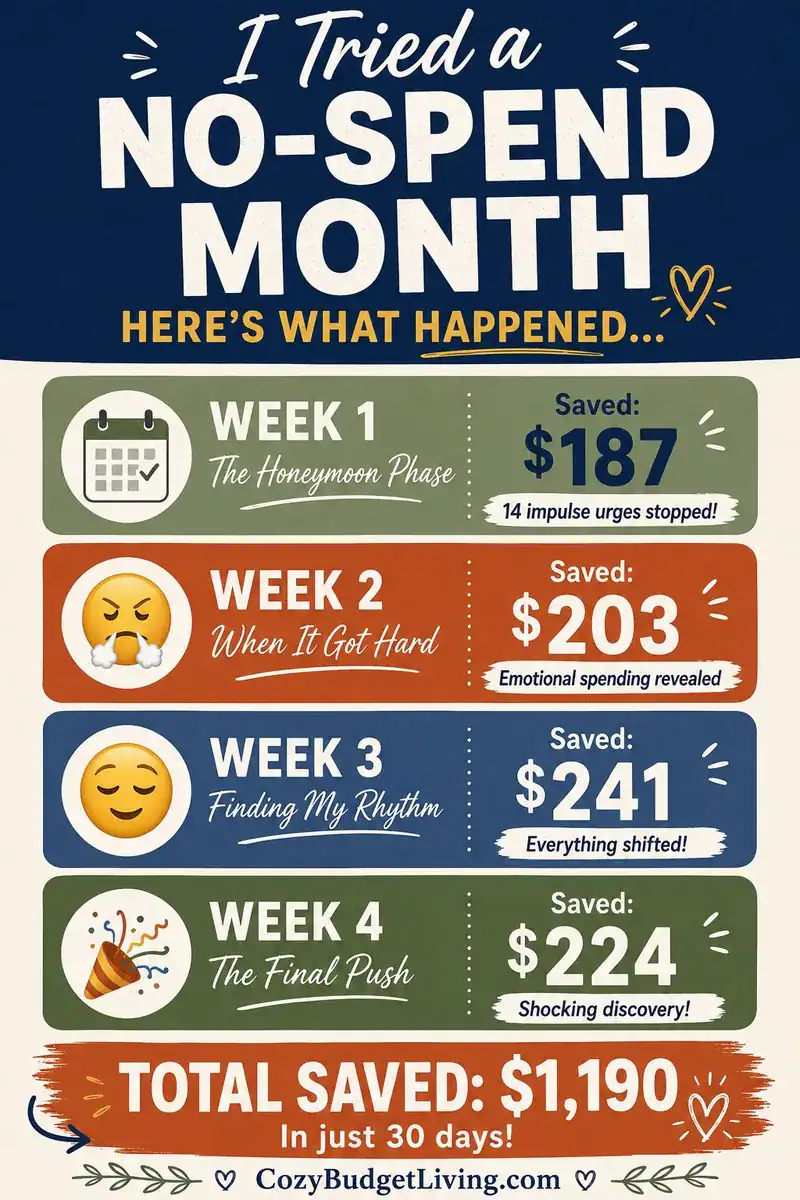
- 3 Week 1 — The Honeymoon Phase
- 4 Week 2 — When It Got Hard
- 5 Week 3 — Finding My Rhythm
- 6 Week 4 — The Final Push and the Unexpected Discovery
- 7 The Final Numbers — What I Actually Saved
- 8 What Was Genuinely Hard
- 9 What Was Easier Than Expected
- 10 What Changed After the No-Spend Month
- 11 How to Do Your Own No-Spend Month
- 12 Frequently Asked Questions
- 13 Q: How much money can you realistically save in a no-spend month?
- 14 Q: What if I fail partway through a no-spend month?
- 15 Q: Can I do a no-spend week instead of a full month?
- 16 Q: What do you do when friends want to go out during a no-spend month?
- 17 Q: Is a no-spend month worth it?
- 18 Conclusion
What Is a No-Spend Month Exactly?
Before diving into my experience, let me clarify exactly what a no-spend month means — because there is a lot of confusion about this.
A no-spend month does not mean spending zero dollars for 30 days. That would be impossible for anyone paying rent, utilities, and buying groceries.
A no-spend month means committing to spending money only on genuine necessities for 30 days — and eliminating all discretionary spending completely.
You CAN spend on during a no-spend month:
- Rent or mortgage
- Utilities — electric, water, heat, internet
- Groceries — basic food items only
- Essential medications
- Gas for work commutes
- Minimum debt payments
You CANNOT spend on during a no-spend month:
- Restaurants and takeout
- Coffee shops
- Clothing and accessories
- Home decor and household items
- Entertainment — movies, events, concerts
- Beauty appointments — haircuts, nails, spa
- Subscriptions beyond essentials
- Online shopping of any kind
- Impulse purchases of any description
The rules seem straightforward on paper. Living them for 30 days is a completely different experience.
Why I Decided to Try a No-Spend Month
I want a no-spend month challenge because — if I am being honest — I had no idea where my money was going.
I was earning a reasonable income. My bills were paid. I had some savings. But at the end of every month, I consistently had less money than I expected — and I could not identify exactly where it was disappearing.
The vague sense that money was leaking somewhere I was not paying attention to was making me anxious. A no-spend month felt like the financial equivalent of an elimination diet — remove everything non-essential, see what you actually need, understand your baseline.
I chose the first full month available, told myself I was committed, and started.
Week 1 — The Honeymoon Phase
The first week of my no-spend month was genuinely exciting. I felt motivated, focused, and proud of myself for making intentional financial decisions.
I cooked every meal at home. I made coffee before leaving the house. I said no to a spontaneous dinner invitation and suggested a potluck at home instead. I felt in control in a way I had not felt about money in a long time.
What surprised me in week 1:
The number of times I reached for my phone to order something — and stopped myself. In the first seven days alone, I counted 14 separate moments where I almost spent money on something non-essential. Fourteen times in seven days. Two times per day on average.
I had no idea I was making that many discretionary spending decisions daily. Most of them were tiny — a $3 app purchase, a $7 lunch upgrade, a $12 book I wanted. But fourteen times in a week adds up to a significant amount over a month, a year, a decade.
Week 1 savings: $187
Week 2 — When It Got Hard
Week two is when the no-spend month stopped feeling like an exciting experiment and started feeling like genuine deprivation.
A coworker’s birthday meant everyone was going out for dinner — and I declined. A sale email arrived from my favorite clothing store announcing 40 percent off — and I deleted it unread. My favorite podcast host recommended a book that sounded fascinating — and I put it on a library waitlist instead of buying it immediately.
None of these individual moments was catastrophic. But the cumulative effect of repeatedly saying no to small pleasures I normally said yes to without thinking created a low-level frustration that built throughout the week.
The hardest moment came on day 11. I had a genuinely awful day at work. I came home stressed and exhausted. Every instinct I had pointed toward ordering delivery food and buying something online to feel better.
I made scrambled eggs instead. I watched something free on YouTube. I went to bed early.
It was fine. But it did not feel fine in the moment — it felt like white-knuckling through something that should not be this hard.
Lesson from week 2: I was using spending as emotional regulation far more than I realized. When stressed, tired, bored, or sad — shopping and food delivery were my default coping mechanisms. The no-spend month forced me to develop alternatives.
Week 2 savings: $203
Week 3 — Finding My Rhythm
By week three, something shifted. The initial novelty had worn off and the early frustration had faded — and what remained was a kind of calm intentionality I had not experienced before.
I stopped feeling deprived and started feeling clear. The constant low-level noise of “should I buy this? I want that. Oh that looks good. Maybe I’ll order from there tonight” — noise I had never consciously noticed before — became quiet.
I discovered that most of the things I normally spent money on impulsively were not things I genuinely wanted or needed. They were habits. Reflexes. Default behaviors that happened automatically without conscious choice.
Breaking those habits for three weeks made me realize how many of them I had — and how little any of them were actually making my life better.
Free things I discovered in week 3:
- My local library has an incredible selection of books, ebooks, audiobooks, and streaming services — completely free
- Walking in a nearby park is genuinely more relaxing than any shopping trip I have ever taken
- Cooking a new recipe from ingredients I already had was more satisfying than any restaurant meal I had ordered that month
- Calling a friend to talk was more connecting than texting while scrolling through a shopping app
Week 3 savings: $241
Week 4 — The Final Push and the Unexpected Discovery
The final week of my no-spend month brought a mix of pride and genuine surprise.
Pride — because I was going to complete something I had committed to. The end was visible and I was going to cross it.
Surprise — because of what I discovered when I finally reviewed my bank account for the entire month.
I knew I had been spending less. I knew approximately how much I was saving week by week. But seeing the full month’s numbers together in one place was genuinely shocking.
Before the no-spend month (average monthly discretionary spending):
- Restaurants and takeout: $340
- Coffee shops: $180
- Clothing and accessories: $120
- Online shopping: $200
- Entertainment and events: $90
- Beauty services: $80
- Subscriptions (non-essential): $45
- Total discretionary: $1,055 per month
I was spending over $1,000 per month on things that were not rent, utilities, groceries, or bills. Over $12,000 per year. On things I could not specifically remember or account for when I looked back at my statements.
Week 4 savings: $224
The Final Numbers — What I Actually Saved
| Category | Normal Month | No-Spend Month | Saved |
|---|---|---|---|
| Restaurants + takeout | $340 | $0 | $340 |
| Coffee shops | $180 | $15 | $165 |
| Clothing + accessories | $120 | $0 | $120 |
| Online shopping | $200 | $0 | $200 |
| Entertainment | $90 | $0 | $90 |
| Beauty services | $80 | $0 | $80 |
| Non-essential subscriptions | $45 | $0 | $45 |
| Impulse purchases | $150 | $0 | $150 |
| Total | $1,205 | $15 | $1,190 |
I saved $1,190 in one month. Not $50. Not $200. Over eleven hundred dollars — in a single month — without changing my income by a single dollar.
What Was Genuinely Hard
I want to be honest about the parts that were difficult — because I think most no-spend month accounts gloss over this and it sets people up for unrealistic expectations.
Social pressure was the hardest part. Almost every social situation in American culture involves spending money. Dinners out. Coffee meetings. Happy hours. Birthday celebrations. Saying no — or suggesting free alternatives — repeatedly over 30 days required more social confidence than I expected.
Emotional spending habits are deeply ingrained. I had no idea how automatically I reached for spending as a response to negative emotions until the no-spend month forced me to find alternatives. This was uncomfortable to confront — but ultimately the most valuable thing I learned.
The physical urge to shop is real. Especially online. The habit of browsing and buying had created a dopamine loop I was genuinely not aware of until it was interrupted. The first week of breaking that loop felt surprisingly unpleasant in a physical way.
What Was Easier Than Expected
Cooking at home — I had been ordering takeout so frequently that I forgot how much I genuinely enjoy cooking. The no-spend month reminded me. I tried seven new recipes and loved five of them.
Free entertainment — The library, YouTube, free museum days, hiking, hosting friends at home — free entertainment options are abundant once you start looking for them. I was genuinely not bored for a single day of the month.
Not buying clothing — I wore outfits I had forgotten I owned and rediscovered items I genuinely like. My closet did not suddenly empty just because I stopped adding to it.
Saying no to sales — Once I deleted the sale emails unread, they stopped being tempting. Out of sight, out of mind proved genuinely effective for online shopping temptation.
What Changed After the No-Spend Month
The no-spend month ended. But something had genuinely shifted.
I did not go back to my previous spending patterns — not because I was forcing myself not to, but because I no longer wanted to. The month had shown me clearly which spending was habit and which was genuinely adding value to my life.
Six changes I kept permanently:
Making coffee at home every day except intentional treats. Cooking at home by default with restaurants as occasional planned events. Unsubscribing from all retail email lists. Using the library instead of buying books. Implementing a 48-hour waiting rule for any non-essential purchase. Canceling four subscriptions I confirmed I did not use or need.
Average monthly savings since the no-spend month: $600 to $800 per month.
Not the full $1,190 — I still go to restaurants sometimes, still buy books occasionally, still enjoy life. But the mindless, automatic, unconscious spending that was draining over $1,000 per month without contributing to my actual happiness? That is gone.
How to Do Your Own No-Spend Month
If my experience has convinced you to try a no-spend month, here is exactly how to set yourself up for success.
Step 1 — Choose your month strategically. Avoid months with major social events, holidays, or known celebrations. A quieter month gives you the best chance of success without constant social pressure.
Step 2 — Define your rules clearly before starting. Write down exactly what counts as a necessity and what counts as discretionary for your specific life. Ambiguity creates excuses. Clarity creates commitment.
Step 3 — Tell someone. Accountability dramatically increases success rates. Tell a friend, partner, or family member what you are doing. Even better — find someone to do it with you.
Step 4 — Plan your meals before each week starts. Food is the biggest temptation for most no-spend month participants. A weekly meal plan with a complete grocery list removes the decision that leads to delivery orders.
Step 5 — Prepare your free entertainment list. Before the month starts, write down 20 free things you enjoy or want to try. When boredom or the urge to spend hits, you have a list ready rather than defaulting to shopping as entertainment.
Step 6 — Unsubscribe from all retail emails on day one. This single action removes one of the most powerful triggers for impulse spending. Takes 15 minutes. Makes the entire month significantly easier.
Step 7 — Track your savings daily. Every evening, calculate what you saved that day compared to your normal spending. Seeing the number grow daily is the most powerful motivation to keep going.
Frequently Asked Questions
Q: How much money can you realistically save in a no-spend month?
This depends entirely on your current discretionary spending. The average American saves $400 to $1,500 during a no-spend month. People with higher discretionary spending save more. The key insight is not the exact number saved — it is the awareness of how much was being spent unconsciously before.
Q: What if I fail partway through a no-spend month?
Keep going. A no-spend month with a few slip-ups is still infinitely more financially beneficial than no attempt at all. The point is not perfection — it is awareness and pattern interruption. If you spend $15 on something non-essential on day 14, acknowledge it and continue. Do not use one slip as an excuse to abandon the entire month.
Q: Can I do a no-spend week instead of a full month?
Absolutely — a no-spend week is a great starting point for complete beginners. It provides the awareness and habit interruption benefits of the challenge with a more manageable time commitment. Many people do a no-spend week monthly as an ongoing practice.
Q: What do you do when friends want to go out during a no-spend month?
Be honest with close friends — most people are supportive and many will be curious or even inspired. Suggest free alternatives — a potluck at someone’s home, a walk, a free community event, a movie night in. For unavoidable social situations like birthday dinners, build in one or two planned exceptions to your rules before the month starts.
Q: Is a no-spend month worth it?
Unequivocally yes — not primarily for the money saved during the month itself, but for the permanent awareness it creates about your spending patterns. Most people who complete a no-spend month continue saving $300 to $700 per month permanently afterward — not through rigid restriction but through the genuine desire to spend intentionally rather than automatically.
Conclusion
I tried a no-spend month — and it changed my relationship with money in ways I did not expect and could not have achieved any other way.
Not because of the $1,190 I saved in 30 days — though that was significant. But because the month forced me to see my spending clearly for the first time — to understand which expenses were bringing genuine value to my life and which were simply habits running on autopilot.
The no-spend month is not about deprivation. It is about clarity. And the clarity it delivers — about your habits, your values, and what actually makes you happy — is worth far more than the money saved.
Try it for one month. Be honest with yourself throughout. And see what you discover about your own relationship with money.
Save this post to Pinterest so you can come back to it when you are ready to try your own no-spend month! 📌
Related Posts You’ll Love: